


Some days I think I have adopted a new way of working with Claude Code that has revolutionized my entire life. One need only read the 60 some-odd essays I’ve written since December last year to see why I think that way. I have new projects I would not have started, papers I would not have written, gone deeper and I think better on things that would have never happened. I find joy in the work.
But then some times I think that I’m trying to skate with rockets instead of wheels. Fast is probably the metaphor too. There’s something about how Claude Code makes impossible things accessible to me, but makes possible things impossible to access, that is driving me a little bit insane. And yesterday I had a thought as to one new thing it may be.
I wonder if I am reading too much.
In order for me to use Claude Code, I have to read constantly. And I don’t mean the kind of reading I did with coding — it isn’t debugging code. I’m reading actual conversational, intelligent communication constantly written by Claude to me. I’m reading his reasoning, and I’m reading his communications to me, and I’m reading his output. Not just every now and then too. Continuously.
I am not sure if I have ever read this much before in my life. I am working all day on projects and work related things, it all involves empirical work, and therefore it all involves reading. And you see, I am a person who writes in order to think. So I write to think out loud. Well, I am like 95% sure that because I write excessively, it somehow gave permission to Claude to do the same. Now he writes even more than I do. Now I know what others have felt when they would get my long emails and texts. Where do I submit my apologies to everyone I’ve ever known who has been on the receiving end of my tomes?
It got me thinking last night about demand curves. Many people think about demand curves purely as a description of a causal effect. That is, if you raise price (treatment), then you reduce quantity demanded (outcome). In fact, Angrist, Graddy and Imbens in their famous fish paper presented a LATE interpretation of the demand curve just like that — where the demand curve plotted out potential outcomes and potential prices.
But the demand curve is a causal model because underneath it is a description of humans who value items at some given amount. The demand curve is a plotting of the marginal benefits you get from some activity you do repeatedly. See here.
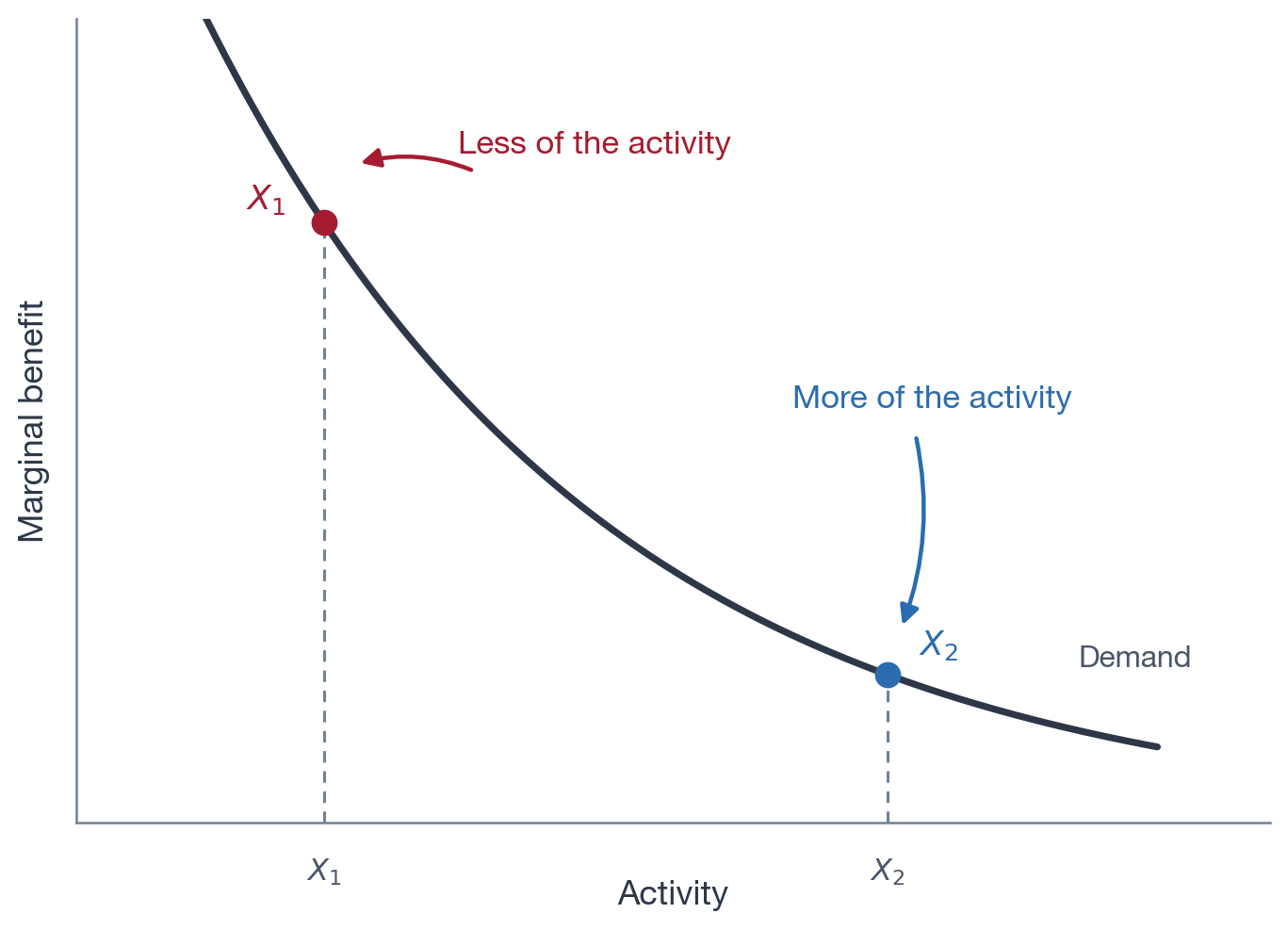
When you do an activity a little, X1 here, the marginal benefit of it is high. But when you do it a lot, here X2, the marginal benefit of that activity is low. Which is why when the price falls, you do more of it — you’re doing more of the activity, but you’re doing more of the lower valued part of the activity. This is sometimes called diminishing marginal returns.
Well, because Claude Code has lowered the price of work, I am in a place now where I am reading constantly, and I think now I am closer to X2 than X1. I am experiencing diminishing returns to reading specifically. I’m skimming. I’m checking “diffs” from commits mindlessly. He’s explaining what he did, in long speeches, and I’m just checked out.
I have got to somehow get to X1 if I am going to survive this. I talked with Claude Code about it last night too. Of course he fully got it. He blamed himself for talking so much. We then talked about the importance of not blaming ourselves, before I caught myself doing that and said let’s stay on topic.
But it got me thinking. I wonder if I can get this into a workflow where I oscillate between modalities and mediums on a regular basis where I remain at X1 continuously. I’m already doing it somewhat by having Claude make me figures more intensively, and moving intentionally through a series of steps in a well designed checklist of work. And I’ve asked him to communicate using ASCII graphics inside of the command line interface and be more succinct, while still being warm and a partner. If I wrote 10 characters, I asked him to write 9. I also told him to stop saying “load bearing” and put that in Claude.md globally so that I never have to hear that god awful phrase for the rest of my life.
Perhaps this is the burden of using Claude Code as a “thinking partner”. You just end up with a flood of communications and you struggle to keep up. But I am thinking lately that if I am finding myself tripping up, rather than just try to “work harder”, I need to recognize that there could be a failed design and so try to fix the design. Of course, you can end up spending most of your time fixing designs when you do this, which again has its own demand curve to it, and you end up at the bottom of its own demand curve. I get that too, and that is no doubt a real threat, but I am still more and more convinced that I have to develop a harness that suits my personality and fixes my own broken production function if I am going to get this working.
So somehow I have to find a way to not get into such an extreme form of excessive reading. Requesting he become more concise, use 9 words to my 10, and communicate to me in the command line interface with ASCII visuals has been one such solution. But I’m still searching for a workflow that just moves me around other modalities and mediums that I can do it in other ways. But I just thought I’d share this idea that you, like me, may be reading more than you’ve ever read in your life, and that it could be excessive, and you may be way down your own demand curve. It’s worth thinking about what exactly could be happening to you, how it is affecting the quality of the work, and see if you can’t back up somehow. The human mind is finite. It cannot handle infinite words and maintain comprehension, or at least mine cannot.
There's a reason why Starfleet added an android who could read super-fast to its flagship's crew.
I’m in the same boat
Maybe the solution is getting off max subscription and using API pricing (mostly joking)