


It’s funny. On the one hand, I would say I am a visual person in that I respond well to pictures when trying to learn and remember things. On the other hand, I do not easily retain those pictures. My memories and my manner in which I navigate my historical life is more influenced by story, metaphor and feelings than it is by those images themselves.
Before AI Agents, like Claude Code, I now notice that my style of workflow had very much become centered around a hierarchy of folders, carefully separated by topics. I, like many people, came to do that, but for me it was more out of necessity than the natural feelings that it was required. I suspect that this is because my mind is not the most organized. I am not a messy person, but I wouldn’t say I know the logical way to organize my home, for instance. Should the couch go here, or should it go there? Do these colors work with the sunlight? What about this plant or plants? Where should I put the bed?
For me those may as well be trying to figure out how to convey what a skyscraper looks like using nothing but interpretative dance. I simply cannot easily experience nor fully comprehend whatever it requires to answer questions around optimal organization, and so I have typically been forced to invent my own organization in response to catastrophic failures. Like finding coding errors early on in my career, which led me to research how others organize their folders, name their files, and automate this, that and the other.
But the movement into using extensively AI agents for my research has created new problems for me. My attitude around AI agents in general is that they solve many of my historic problems but also create new ones. I do not lament this; I just see it as my job to solve these problems. I hold no sympathy for the dying world, anymore than I feel sympathy for lost days of typewriters, buggies and poorly fit boots.
And yet some of these problems are like the description above with regards to arranging the furniture in my house. The arrangement of furniture in the house is endogenous. It is endogenous to the layout of the house, where the natural light comes in, where supporting walls are, how large the windows are, and perhaps more than all, what experiences I want to have, phenomenologically, when in that room. But it is also endogenous to my tastes. And I cannot solve this endogeneity problem without skill and human capital in something as basic as design.
Well, I think it is the same with using AI agents to be honest. The structure of work has completely shifted, but unlike the models I study in economics, I know that the creation of the new equilibrium will require that I personally create something new.
I think so far I have been focused on /skills, almost exclusively. Almost atomistic like. Do my normal thing, but use a /skill to do it. So keep making decks, but use /beautiful_deck to make the decks. Keep writing code, but use /referee2 to check and validate the code. But something is not working perfectly, and I cannot yet quite put my finger on what it is, why it is, and how to set up the new workflow.
I am going to reread David Allen’s classic productivity book Getting Things Done, or at least start there, to try and see if I cannot understand from core principles how to redesign my workflow. Just like I had once made the structuring of folders my core foundational blueprint to research, I need to go even deeper. I need to figure out how to create the optimal human-in-the-loop system. Where do I insert myself exactly in this new production function? Recall from this quote from William Shockley, the 1957 winner of the Nobel Prize in physics, wherein he laid out a simple conjecture that the production function of scientific output followed a multiplicative model that led to a log normal distribution in productivity in scientists.
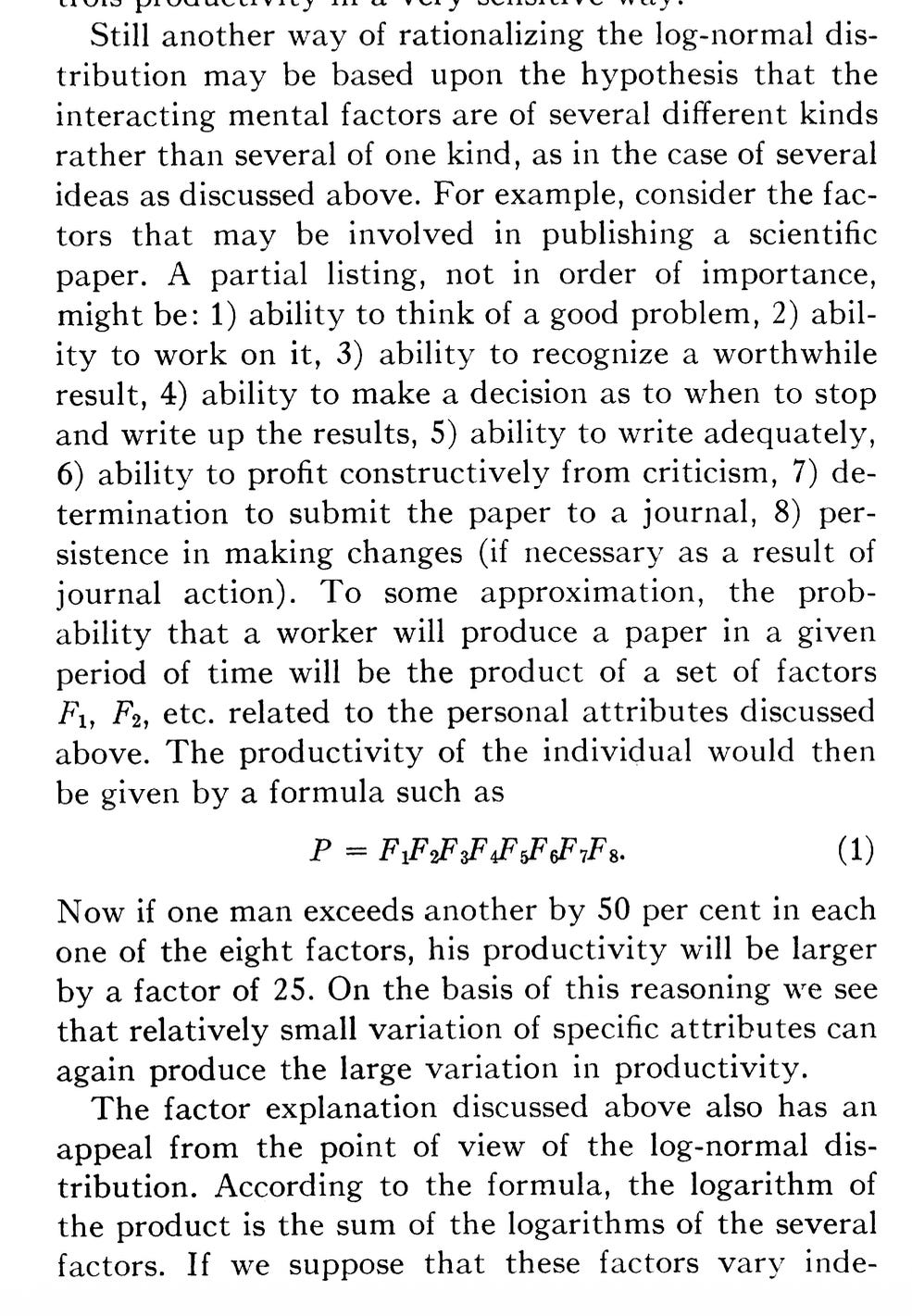
I am intent on leveraging and squeezing every last drop out of AI agents to augment that entire pipeline for me. But to do that, I have to start over from fundamentals and think about what is the workflow of research in a way that is as simple as humanly possible. I have to have some way, for instance, to record my conjectures and interpretations given I am not more degrees removed from the typing of actual code. Such typing tasks had historically, for some reasons, placed me into a kind of flow state where ideas got imprinted, nearly permanently, into a kind of muscle memory. So now where do I put them?
And maybe even as importantly — how will I visualize those ideas? Will I only rely on “beautiful decks”? Could I create dashboards? Do I make markdowns of every idea? One markdown? Fifty markdowns? In a folder? How much do I give up? How much do I protect as my own territory? What are the property rights between me and Claude Code exactly, over what tasks, and why?
So, I think that my next goal will not be a /skill. My next goal is the AI Agent equivalent of coming up with a new workflow, and this is probably where I am going to have to start creating harnesses. What is an AI Agent harness? What is it specifically for economic and social scientific research? Consider this definition.
AI agents today are more than just standalone models that take in and output text tokens. They operate within an ecosystem of tools, memory stores, and orchestrated workflows that enable them to perform complex tasks. In this context, a new term has emerged in the AI lexicon: the “harness.”
In simple terms, an agent harness is the software infrastructure that wraps around a large language model (LLM) or AI agent, handling everything except the model itself. One AI architect defines an agent harness as “the complete architectural system surrounding an LLM that manages the lifecycle of context: from intent capture through specification, compilation, execution, verification, and persistence”, essentially everything except the LLM itself. In practical terms, the harness is what connects an AI model to the outside world, enabling it to use tools, remember information between steps, and interact with complex environments.
So, I think that Allen’s Getting Things Done is going to be my starting point, as that is a productivity philosophy as opposed to a collection of productivity tools. I think the tools are endogenous to the philosophy, and not the other way around — at least for me. I will therefore probably be trying to experiment on here with sketching out a new harness that is appropriate for the type of research I do. As with skills, such things are probably highly idiosyncratic to the individual, but also as with skills, I suspect that there is an inherent “optimal” structure. I just don’t think I know quite what it is yet, but I have to figure it out if I am going to simultaneously enhance my research productivity and reduce errors to zero.
Brilliant. I am committed to doing the same.
Funny you mentioned GTD, I went through a similar reflection on a recent post about how AI agents increase how much we can do, but also require supervision/management. GTD came to mind and I mentioned it there. I’m testing something based on LLM wiki to try to organize everything (personal + work/research). So far it’s been working well, with Obsidian being useful to navigate/edit (on top of telling agent to do it) and can also do some visualization.